
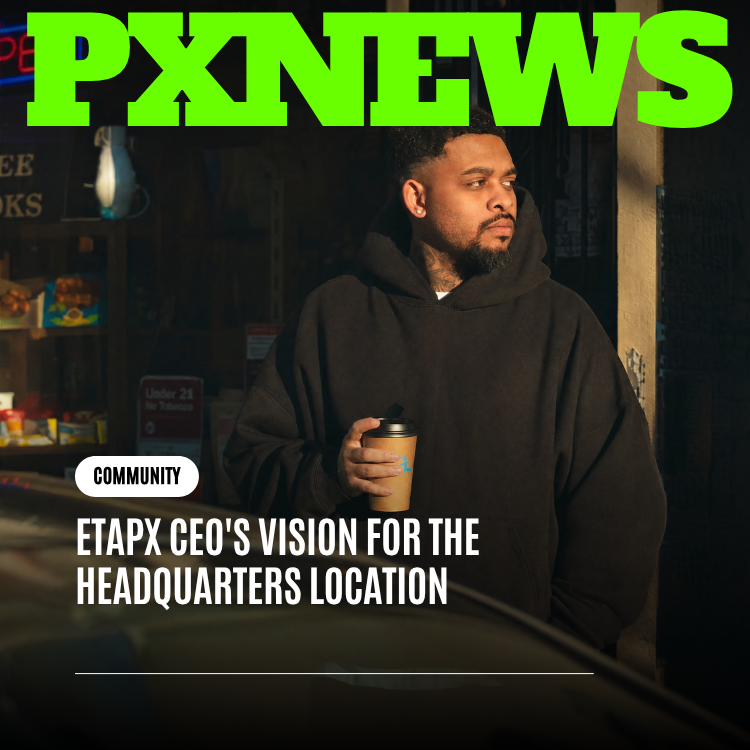
ETAPX's headquarters is not a mailing address or a line on a careers page — it's a deliberate bet AJ, our founder and CEO, made against the industry's post-2020 default of going remote-first. Building Whistlr the way he wanted it built meant putting people in a real room, inside the same ecosystem that sets the pace for the industry it lives in. This is his reasoning, in his own words, for why that bet was worth making, and what the building becomes next.
Ask most founders why their company is headquartered where it is, and you'll get some version of a shrug: it's where they happened to be when they started, or it's where the first few hires already lived. That's a perfectly honest answer. It's just not ETAPX's answer. AJ treats the headquarters as one of the company's actual decisions, made on purpose and defended the way any other strategic call would be — not an accident of geography, and not a default inherited from an era when almost nobody was making the decision consciously at all.
This also isn't a piece about what it's like to be a startup working inside the Bay Area's broader tech and AI moment — that's a real story, and it's one we've told elsewhere on PX News. This is narrower and more personal: why AJ chose to put ETAPX in a real building, in this specific region, instead of letting Whistlr get built by a team scattered across time zones and status updates, and what he thinks that building is actually for, now and as the company grows.
Why We Never Seriously Considered Going Remote-First
"Going remote-first would have been the easy call — cheaper leases, a wider hiring map, a founder story everybody already believes. That was never the hard part. The hard part was admitting that the Whistlr I actually wanted to build wasn't going to come out of a team that only ever met on a screen, and choosing to pay for a room instead."
— AJ, Founder & CEO at ETAPX
By the time ETAPX was making real hiring and location decisions, remote-first wasn't just an option on the table — it had become the assumed sophisticated choice, the thing you said in a pitch meeting to signal you understood the modern way of building a company. Distributed teams, async updates, a hiring map with no borders. On paper the case is genuinely strong, and there's no point pretending otherwise: it's cheaper, it opens the hiring pool to the entire planet, and a large share of the software industry has made it work.
AJ looked at that case seriously, not dismissively, and still landed on no. Not because remote work doesn't work — plenty of companies prove every year that it does — but because the specific thing ETAPX was trying to do with Whistlr wasn't a generic software problem with a generic best practice already attached to it. It was a judgment-heavy, taste-heavy, pace-sensitive problem, and problems like that have historically gotten solved fastest by people who share a room, not just a group chat.
That's the actual shape of the decision. Not a rejection of remote work as an idea, and not a claim that it's the wrong choice for every company at every stage. A refusal, specifically, to inherit a default nobody at ETAPX had actually tested against what the company was trying to build.
What Density Actually Buys You
"Proximity" can sound like a vague, nostalgic word — the kind of thing people say about offices because they miss the free coffee, not because they can point to what it actually does. AJ's version of the argument is more specific than that, and it comes down to a short list of concrete things a shared room provides that a video call has never fully replicated, no matter how good the video call gets.
- Faster decisions, not just faster meetings: A hard call about the feed gets resolved in the ten minutes after someone says "wait, look at this," instead of getting scheduled for Thursday's sync.
- Recruiting pull: The people ETAPX most wanted to hire for Whistlr were already choosing to live near the rest of the industry; a real office met them where they already were, instead of asking them to prove they'd stay engaged from somewhere else.
- Calibrated taste: Whistlr's feed decisions live or die on judgment calls that are hard to explain convincingly in a written brief and easy to align on in five minutes standing at someone's desk.
- Harder to fake momentum: A team in the same room can't quietly coast the way a distributed team sometimes can behind a status update that says "on track."
None of that is a claim that remote teams can't make good decisions, hire well, or move fast — plenty clearly do. It's a claim about what ETAPX specifically needed while Whistlr was being built, at the speed AJ wanted it built at.
The Room Where Whistlr Actually Got Built
AJ points to one underlying reason the headquarters mattered to Whistlr: proximity turned slow, abstract debates into fast, resolved ones.
A social feed is built out of hundreds of small, contestable judgment calls — what gets surfaced, what a "Best" sort actually rewards inside a SubCircuit, how loud a notification should be before it stops respecting someone's attention. Those calls are hard to write down convincingly in a spec, and easy to argue through out loud with someone looking at the same screen you are. AJ's read is that Whistlr's early feed, Circuits, and Waves decisions moved as fast as they did specifically because the people making them were rarely more than a few steps apart.
The Cost We Accepted on Purpose
It would be dishonest to describe this as a decision with no downside, and AJ doesn't pretend otherwise. A real headquarters is a real, ongoing commitment, not a line item you pause the way you'd pause a software subscription. It narrows the hiring pool to people willing to be in the same place, or willing to move there, which is a genuine filter and, for some excellent candidates, a genuine disqualifier. It's slower to stand up in a new city than a job posting is to publish. And it means ETAPX carries overhead a fully distributed competitor simply doesn't.
AJ's position isn't that these costs are small. It's that they're worth paying for what they buy back, at the stage ETAPX is at, building the specific things it's building. A company optimizing purely for hiring-pool size or burn rate would probably make a different call than ETAPX did. ETAPX optimized for something else: the speed and quality of the judgment calls behind Whistlr, which AJ has been direct are worth more to the company right now than a marginally larger applicant pool.
A Place You Show Up To, Not a Mailing Address
Plenty of companies have a "headquarters" that is, in practice, a registered agent's address and a floor of shared office space nobody from the actual team has ever stood in. AJ is blunt about not wanting that for ETAPX. The building matters to him less as an address and more as a claim: that there are people who show up, in person, to build Whistlr, on purpose, every day — and that the company is willing to be judged by whether that's actually true.
"When we've invited a handful of people from Campus in for a small meetup, what we hear back is that it completely changed how they think about the company. They'd only ever known ETAPX as an app icon and a Discord they check way too often. Now they've seen a place where actual people build the thing they use every day, not just a logo somewhere."
— AJ, Founder & CEO at ETAPX
That distinction — a place people show up to, versus an address a company merely has — is, in AJ's telling, most of the actual argument for keeping a physical headquarters at all. A mailing address doesn't develop a culture. A room full of people who keep choosing to be in it, day after day, does.
Why the Bay Area, Specifically
Choosing to have a physical headquarters and choosing where to put it are two different decisions, and AJ is direct that the second one wasn't arbitrary either. It's not that any office in any city would have done the job. ETAPX needed to be inside the specific ecosystem that produces the talent, the ideas, and the competitive pressure that shape Whistlr — and that ecosystem is concentrated here in a way it simply isn't concentrated everywhere.
For Whistlr, that proximity is real: the pace of consumer social and creator products, the caliber of engineering and design talent willing to work on them, and the density of people who'll actually give sharp, informed feedback on a new feature are all higher here than almost anywhere else. AJ isn't claiming the Bay Area is the only place a company like ETAPX could exist. He's claiming it was the right place for this one, at this stage, building these specific products — a narrower and more defensible claim than "every startup belongs here," and the only one he's actually making.
What the Building Becomes as ETAPX Grows
Ask AJ what the headquarters is for today, and he'll tell you it's mostly for the people building Whistlr — a place for the team, first. Ask him what it's for in five years, and the answer changes. The plan isn't for the building to stay a private space that only employees ever walk into. It's for the physical headquarters to eventually do for the community in person what Campus, ETAPX's Discord server, already does in real time online: give people who care about what ETAPX builds an actual, direct way in.
That doesn't mean turning the office into a public lobby, and AJ isn't describing an open-door policy starting tomorrow. It means the small meetups already happening with Campus members are a first, deliberate step rather than a one-off — a preview of a headquarters that hosts events, welcomes creators and community members in, and treats the Campus Store and the Discord server as connected to the same physical place instead of living in a separate universe from it. A company that talks about community as a real relationship, not a marketing word, eventually has to prove it with a door someone outside the company gets to walk through.
"A headquarters that only employees ever see is just an expensive office with good branding. We didn't build this so it could sit on a careers page. A place only really earns the word 'headquarters' once people outside the company have an actual reason to walk through the door too — and that's the direction we're taking it."
— AJ, Founder & CEO at ETAPX
Frequently Asked Questions
Is ETAPX a remote company?
Not by default. ETAPX is headquartered in the Bay Area with a real office the team works from, and that was a deliberate choice rather than something the company backed into. It isn't a blanket claim that remote work doesn't work generally — it's specific to what ETAPX needed while building Whistlr.
Why did AJ choose the Bay Area for ETAPX's headquarters?
Because of what's concentrated there: the talent pool, the pace of the industry, and the broader tech ecosystem Whistlr draws on. AJ's argument isn't that every company belongs there — it's that ETAPX's products benefited enormously from sitting inside that ecosystem rather than somewhere adjacent to it.
Can community members visit ETAPX's headquarters?
Not as a general walk-in space today, but ETAPX has started inviting Campus community members in for small meetups, and AJ has said the plan is to open the space to more community events as the company grows.
Does everyone at ETAPX work from the office?
The office is the team's real center of gravity rather than a formality, though the specifics of any individual role are a hiring conversation, not a policy laid out in a blog post. The point isn't a mandate — it's that the default at ETAPX is a real room, not a standing video call.
Will ETAPX open more offices as the company grows?
Nothing specific is being announced here. AJ's stated instinct is to deepen what the current headquarters does, for the team and increasingly for the community, before assuming more locations is the right next move.
How does the headquarters relate to Campus, ETAPX's Discord community?
Today they're mostly separate: Campus is the real-time online home for the community, and the headquarters is where the team builds day to day. AJ's stated direction is to close that gap over time, using the physical space to host the same community Campus already serves online.
None of this is a verdict on remote work, and it isn't a claim that a physical headquarters is the only serious way to build a company — plenty of great ones prove otherwise every year. It's a narrower, more personal claim, and it's specifically AJ's: the version of Whistlr he wanted to build needed a room, not just a network, and the room needed to be here. Whatever the headquarters becomes next — bigger, louder, open to more of the community than just the people on payroll — the plan is for it to stay exactly what it was on day one: a place people actually show up to, to build something real.