
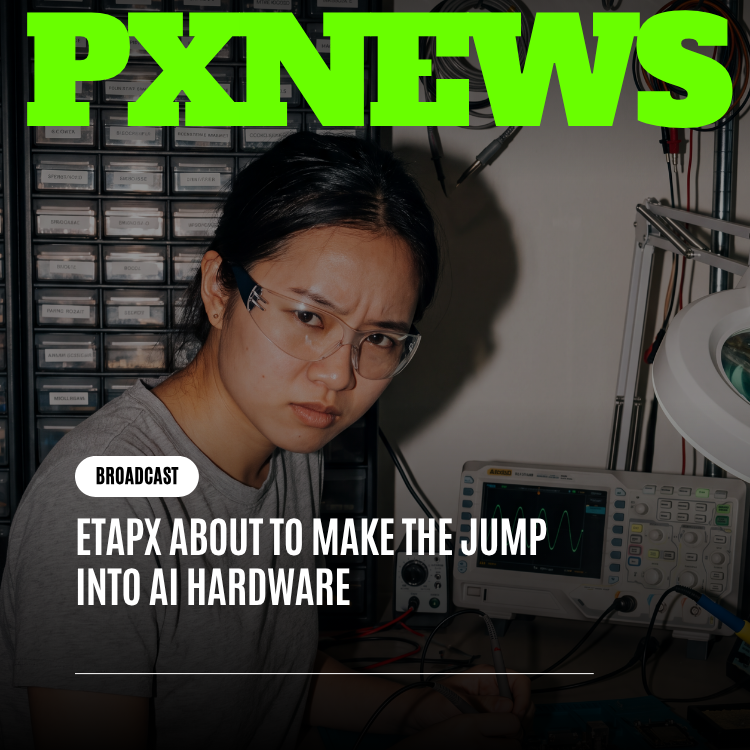
ETAPX has been a software company for the entirety of its history, building Whistlr and everything else in its lineup without ever once touching a physical product. That changes today, in one specific and limited way: we're beginning to explore AI hardware as a new category for the company, our first deliberate jump into hardware since ETAPX started. There is no device to show and no shape decided yet — what exists is a question we think is worth taking seriously, about what happens when our "outcome over conversation" philosophy runs into the simple fact that acting on a thought still requires opening a screen. This is the start of that exploration, told as honestly as we know how: early, unfinished, and in no hurry to pretend otherwise.
The Jump Into Hardware We're Talking About
Say "hardware" next to "AI company" in 2026 and most people assume a specific set of things: a keynote, a device on a table, a pre-order link, a countdown clock. None of that is what's happening here, and we'd rather say so plainly than let anyone assume otherwise for the length of this article. What we're announcing is narrower, and we think more honest: ETAPX is beginning to explore AI hardware as a real category for the company, for the first time in our history. That's the whole announcement. Everything else in this piece is us explaining why we think that's worth doing at all, not what we're going to sell you.
It's worth sitting with how unusual this is for us specifically. Whistlr and the rest of our lineup solve different problems, and every one of those products shipped as software, running on devices somebody else designed, built, and sold. We've never had a reason to think about a physical object as part of what ETAPX makes. The jump into hardware is us saying that reason may finally exist — not because hardware is having a moment, and not because everyone else building agentic software is starting to eye the same territory, but because of a specific, recurring piece of friction we keep running into, described in the next section.
Why Software Alone Keeps Hitting the Same Wall
Our agentic software rests on a single premise: you describe an outcome, and the work actually gets carried out, end to end, instead of stopping at a good answer. That premise is holding up. The part of the problem it was built to solve — what happens after you've decided something needs doing — keeps getting better the more we invest in it. But building around it long enough eventually surfaces a different problem sitting one step earlier, a problem no amount of improving the software itself was ever going to fix, because it isn't a problem inside the software. It's a problem in the distance between you and the software.
The Gap Between Thought and Action
Here's the shape of it. An agentic thought — something worth handing off, something that would genuinely be better carried out than carried around in your own head for the rest of the day — rarely arrives at a convenient moment. It shows up while your hands are full, mid-conversation, halfway through something else entirely. Acting on it means stopping what you're doing, finding a phone, unlocking it, finding the right app, and typing out something that was, moments earlier, a complete and specific thought. Some of that friction is simply unavoidable — that's the nature of doing anything at all. But most of it is a tax every piece of software charges for the privilege of being reached in the first place, no matter how good the work is once it actually gets there.
That tax is easy to underestimate, because no single instance of it feels expensive. It's a few seconds, a minor interruption, hardly worth mentioning on its own. What we think is actually happening is a cost that looks trivial multiplied across every time it happens in a day, a week, a year — until a genuinely agentic thought only survives the walk to your phone some of the time. Some thoughts don't survive that walk at all. They evaporate somewhere between having them and being in front of a keyboard, and the work that would have gotten carried out never gets described to anything in the first place.
Why a Physical Device, and Why Now
Once you see that gap clearly, the next question is obvious: why would a physical device be the answer, and why would a software company be the one to explore it? We don't have a settled answer to the first half yet — that's exactly what "exploration" means here, and we're not going to dress up a hunch as a conclusion. But we have a clear answer to the second half, and it's the same answer underneath everything else ETAPX has built. If the goal is genuinely shortening the distance between having a thought and getting it acted on, that distance eventually runs into the physical world, because the person having the thought lives in the physical world and the screen doesn't. Software can keep getting better at what happens after you reach it. Only something physical can change how long it takes to reach it at all.
This isn't ETAPX noticing hardware is having a moment and deciding to have one too. We've written before about the pull every AI company feels to chase whatever's trending, and why we've tried to hold a hard line against building things for that reason alone. This doesn't pass that test because it's fashionable. It passes because it's the same thesis we've already bet the rest of the company on, run one step further than we'd previously taken it.
"We've always bet that the point of AI was never the conversation, it was the outcome — getting you out of the loop once you've described what you need. But 'once you've described it' was hiding an assumption — that describing it was already easy, already fast, already close at hand. The more we sat with that, the more it looked like the same unfinished thought, just applied to the physical world instead of the software one. That's the whole reason we're willing to look at hardware at all. It's not a new philosophy. It's the same one, finally pointed at the part of the problem software can't reach on its own."
— AJ, Founder & CEO, ETAPX
Not a Trend Chase
It matters to us that this reads as continuation rather than reinvention. ETAPX didn't sit down, notice a hardware wave forming, and look for a philosophy to retrofit onto a device. The philosophy came first, years before this conversation started, and the device question only showed up once the philosophy had been tested seriously enough in software to reveal its own edge. That order matters more than it might seem. It's the difference between a company borrowing relevance from a category and a company running its own idea out to its logical next question.
What "Early" Actually Means in Practice
"Exploring hardware" is a phrase that can mean almost anything, and we'd rather be specific about what it means at ETAPX right now than let it sound bigger than it is. It does not mean a secret lab, a locked roadmap, or a device already taking shape behind a door nobody else at the company can open. It means a small, deliberate set of activities that look a lot less exciting than the phrase "AI hardware" might suggest, and that's intentional.
- Research first: understanding how existing hardware categories actually work, where they succeed, and where they quietly fail the people using them, before assuming we'd do any better.
- Small internal experiments: rough, limited explorations built to test a specific question about the problem, not a specific answer about the product — work that's meant to be thrown away as often as it's kept.
- No fixed shape yet: we haven't settled on a form factor, and we're treating that as appropriate for where we are, not as a gap to paper over with a premature decision.
- No committed timeline: there's no release date, because there's nothing yet to release a date for, and inventing one before the thinking is done would be exactly the kind of rushed move we've built a reputation on avoiding.
- Learning in public where it's genuinely ready to share: we'd rather tell people what we're actually thinking about, in honest pieces, than disappear for years and reappear with a finished reveal nobody got to see coming.
Learning in Public, Not a Five-Year Roadmap Reveal
That last point is a real departure from how a lot of hardware gets built. The industry default is secrecy — build in a sealed room for years, control every leak, and stage a single dramatic reveal once the thing is finished enough to survive contact with an audience. We understand why companies do it that way, and we're not claiming a moral high ground over anyone who does. We're choosing a different rhythm because it's the same rhythm we've used for everything else, not because secrecy is inherently wrong. Whistlr became a public conversation well before it was a finished conversation, and that's stayed true even when the honest update was "here's what we tried that didn't work."
"Right now the entire job is asking better questions, not producing better answers. On my side, that's meant the least glamorous version of the work there is — reading, studying how other devices were introduced to people, what they got right and where the story didn't match the product, and taking notes that will never leave a notebook. None of that is a roadmap. It's just what taking something seriously looks like before you're allowed to have opinions about it yet."
— John Barnes, Marketing Operations Executive, ETAPX
AJ and the Discipline of Building the First Physical Thing
AJ, ETAPX's Founder & CEO, builds from a simple instinct: notice a problem, get close enough to it to actually understand it, then go build toward an answer. That instinct is exactly what's driving this exploration too. The difference this time is that the problem lives partly outside software, in a discipline AJ would be the first to admit ETAPX doesn't have the same instincts for yet.
Software Habits Don't Transfer Directly to Atoms
Software forgives a certain kind of impatience that hardware doesn't. You can ship a rough version of a feature, watch what breaks, and fix it by the next afternoon. A physical object doesn't work that way — decisions get expensive to reverse much earlier in the process, and the feedback loop between "we tried something" and "we know if it was right" stretches from hours out to months. AJ has been direct about that adjustment inside the company, and about resisting the urge to treat early hardware exploration with the same fast, iterative confidence that's worked well for shipping software.
"Every instinct I have was trained on software, where being wrong is cheap and fast to fix. I have to actively slow that instinct down right now, because being wrong about a physical decision doesn't cost an afternoon, it costs months, and you don't always find out you were wrong until a lot later than you'd like. That's not a complaint. It's just true, and pretending otherwise would be the fastest way to spend a year building the wrong thing with total confidence."
— AJ, Founder & CEO, ETAPX
That humility is doing real work here, not just decorating the announcement. A founder willing to say "my instincts are calibrated for the wrong medium" in public is more likely to actually build the right thing eventually, because nobody is pretending the transition is smaller than it is. AJ describes moving deliberately slower here — not from any lost appetite for building fast, but by applying that appetite to learning the constraints first, before applying it to anything resembling a real decision.
What We're Not Saying Yet
Because the phrase "AI hardware" invites speculation almost automatically, it's worth being unusually direct about what this announcement does not include. There is no chip chosen, no sensor selected, no battery target, no material decided, no manufacturing partner lined up, no release date, and no price, because none of those decisions exist yet. Anyone telling you otherwise, including a version of this article that hedged less carefully, would be inventing specifics to make an early idea sound more finished than it actually is. We'd rather you know exactly how early this is than let the excitement of the announcement imply certainty we don't have.
That's not a hedge we're hiding behind. It's the actual, deliberate position — the same one we've held publicly about resisting pressure to move faster than the thinking justifies, applied here to a category where the temptation to overpromise is especially strong. A hardware announcement with no specs is an unusual thing to publish. We think it's a more honest thing to publish than the alternative, which is picking a plausible-sounding set of specs before we've earned the right to be confident in them.
"We could make this announcement sound bigger by attaching a made-up spec sheet to it, and it would read better for exactly as long as it takes someone to ask a follow-up question we can't answer honestly. We'd rather tell you what we don't know yet than dress up a guess as a plan. That's cost us the flashier version of this post. I think it's bought us something worth more, which is you actually believing the next thing we tell you about this."
— AJ, Founder & CEO, ETAPX
What we can commit to is narrower, and we think more useful: as this exploration produces anything real enough to share honestly, PX News is where it will show up first, described with the same plainness as this piece. No leaks to manage, no hype cycle to feed. Just an honest account of where the thinking actually is, updated as it actually changes.
Frequently Asked Questions
Is ETAPX actually building an AI hardware product?
Not yet, and not in the sense most people mean when they hear that question. ETAPX is beginning to explore AI hardware as a new category, not announcing a finished product. Right now that means research, small internal experiments, and honest thinking about a real problem — it doesn't mean a device exists, even in early form, with a fixed shape or a committed release date.
Why is ETAPX making the jump into hardware now?
Our agentic software is built around outcome over conversation — describing what you need done and having it actually carried out. The more that thesis proved out in software, the more we noticed it was bottlenecked by something software can't fix on its own: acting on an agentic thought still requires opening a screen. The jump into hardware is us taking that bottleneck seriously instead of ignoring it because it falls outside our usual territory.
What will the device actually do?
We don't know yet, and we're not going to guess in public just to fill this answer with something concrete. In principle, the idea we're exploring is something that shortens the distance between having a thought worth acting on and getting it acted on, without requiring the usual detour through unlocking a phone and opening an app. What that becomes in practice is still an open question, not a settled feature list.
Is this a departure from ETAPX's usual pace and approach?
No — if anything, it's the same approach applied to new territory. We've written before about resisting the pull to chase every trend just because it's trending, and this exploration is being held to that same standard. Nothing about moving into AI hardware changes our preference for shipping when something's actually ready over shipping because a calendar said to.
When will ETAPX share more about this?
Whenever there's something real and honest to say, and not before. We'd rather update this story in small, truthful pieces on PX News as the exploration actually progresses than disappear for years and return with a single staged reveal. If the thinking changes direction, stalls, or produces something worth showing, this is where it gets described first.
None of this is a launch, and we've tried hard in this piece not to let it read like one. It's a company that has only ever shipped software admitting that one specific problem — the gap between having a thought worth acting on and actually acting on it — might not be fully solvable inside a screen, and deciding that's worth taking seriously rather than filing away. ETAPX's jump into hardware starts here, at the least exciting and most important part: asking the question honestly before pretending to know the answer. We'll tell you what we learn as we learn it.